MAGE - With TIEGCM (GTR) Quick Start
These instructions illustrate the process of running a geospace simulation using the MAGE model coupled with TIEGCM. We call this version of the model “GTR” (“GAMERA-TIEGCM-RAIJU”) for brevity.
Before you begin
Setting environment variables
Source (not run) the environment setup scripts for the kaiju software and add paths to TIEGCMHOME and TIEGCMDATA.
For example:
source /path/to/your/kaiju-clone/scripts/setupEnvironment.sh
export TIEGCMHOME=/path/to/your/tiegcm
export TIEGCMDATA=/path/to/your/tiegcm/data
Note
The TIEGCMHOME and TIEGCMDATA environment variables are required
for running the GTR model. They should point to the TIEGCM source code
directory and the TIEGCM data directory, respectively.
- The TIEGCMDATA directory is located in the following locations:
On
derecho:/glade/campaign/hao/itmodel/tiegcm3.0/new_dataOn
aitken:/nobackup/nrao3/tiegcm/tiegcm3.0/dataThe required data files can be downloaded from the NCAR Globus endpoint using the following link: TIEGCM Data Files
Running a geospace simulation with MAGE
The MAGE software needs several files in order to run. The detailed steps
for creating these files have been combined into a script called
engage.py. The script is provided in the kaiju code repository. More
information on engage.py is available
here.
You can see the options supported by engage.py by running it with the
--help or -h command-line option.
engage.py --help
usage: engage.py [-h] [--clobber] [--debug] [--mode MODE] [--engage_options_path ENGAGE_OPTIONS_PATH] [--makeitso_options_path MAKEITSO_OPTIONS_PATH] [--tiegcm_options_path TIEGCM_OPTIONS_PATH] [--verbose]

Interactive script to prepare a MAGE geospace model run.

options:
-h, --help            show this help message and exit
--clobber             Overwrite existing options file (default: False).
--debug, -d           Print debugging output (default: False).
--mode MODE           User mode (BASIC|INTERMEDIATE|EXPERT) (default: BASIC).
--engage_options_path ENGAGE_OPTIONS_PATH, -eo ENGAGE_OPTIONS_PATH
                        Path to engage JSON file of options (default: None)
--makeitso_options_path MAKEITSO_OPTIONS_PATH, -mo MAKEITSO_OPTIONS_PATH
                        Path to makeitso JSON file of options (default: None)
--tiegcm_options_path TIEGCM_OPTIONS_PATH, -to TIEGCM_OPTIONS_PATH
                        Path to tiegcm JSON file of options (default: None)
--verbose, -v         Print verbose output (default: False).
Running engage.py
For this example, we will run the code on derecho, and use the default
BASIC mode, which requires the minimum amount of input from the user. At
each prompt, you can either type in a value, or hit the Return key to
accept the default value (shown in square brackets at the end of the prompt).
First we will create a directory for this run in your scratch space.
mkdir quickstart_gtr
cd quickstart_gtr
Copy the executables you built in the previous steps to your run directory.
Note
The TIE-GCM executables for a Q run was built in the tiegcm_build_Q directory in the build guide.
cp $TIEGCMHOME/tiegcm_build_Q/stdout/tiegcm.exe .
cp $TIEGCMHOME/tiegcm_build_Q/stdout/tiegcm.x .
cp $KAIJUHOME/build_gtr/bin/voltron_mpi.x .
Run
engage.pywith no arguments:
$KAIJUHOME/scripts/makeitso/engage.py

tiegcmrun from /glade/u/home/nikhilr/kaiju_engage/tiegcm/tiegcmrun/tiegcmrun.py
makeitso from /glade/u/home/nikhilr/kaiju_engage/kaiju-private/scripts/makeitso/makeitso.py

Name to use for PBS job(s) [geospace]:
Start date for simulation (yyyy-mm-ddThh:mm:ss) [2001-06-01T23:00:00]:
Stop date for simulation (yyyy-mm-ddThh:mm:ss) [2001-06-02T01:00:00]:
Do you want to split your job into multiple segments? (Y|N) [Y]:
Segment length in simulated seconds [7200.0]: 3600
GAMERA grid type (D|Q|O|H) [Q]:
Name of HPC system (derecho|aitken) [aitken]: derecho
PBS account name [<YOUR_ACCOUNT_HERE>]:
Run directory [.]:
Path to kaiju installation [<YOUR_KAIJUHOME_HERE>]:
Path to kaiju build directory [<YOUR_BUILD_DIRECTORY_HERE>]:
PBS queue name (develop|main) [main]:
Job priority (regular|economy) [economy]:
WARNING: You are responsible for ensuring that the wall time is sufficient to run a segment of your simulation!
Requested wall time for each PBS job segment (HH:MM:SS) [01:00:00]: 12:00:00
Root directory for the simulation [<YOUR_RUN_DIRECTORY_HERE>]:
Conda environment to use for the simulation [<YOUR_CONDA_ENVIRONMENT_DIRECTORY_HERE>]:
Warning
Make sure to set Path to kaiju build directory to the directory where you built the
voltron_mpi.x executable with the module set for GTR runs. If you followed the build
instructions, this should be the build_gtr subdirectory. This is required for running
the model in GTR mode.
engage.py will then prompt you for the following additional information from makeitso:
Extend TFIN by dtCouple - 1 seconds (T|F) [T]:
(VOLTRON) Run in GCM mode (T|F) [T]:
Do you have an existing boundary condition file to use? (Y|N) [N]:
(GAMERA) Relative path to HDF5 file containing solar wind boundary conditions [bcwind.h5]:
(VOLTRON) File output cadence in simulated seconds [60.0]:
After these inputs, the script fetches data from CDAWeb for the specified time range to use in the solar wind boundary condition file.
You should see output similar to this:
GGenerating Quad LFM-style grid ...

Output: lfmQ.h5
Size: (96,96,128)
Inner Radius: 2.000000
Sunward Outer Radius: 30.000000
Tail Outer Radius: 322.511578
Low-lat BC: 45.000000
Ring params:
<ring gid="lfm" doRing="T" Nr="8" Nc1="8" Nc2="16" Nc3="32" Nc4="32" Nc5="64" Nc6="64" Nc7="64" Nc8="64"/>

Writing to lfmQ.h5
14-Jun-25 19:30:03: /glade/work/nikhilr/conda-envs/kaiju-3.12/lib/python3.12/site-packages/spacepy/time.py:2448: UserWarning: Leapseconds may be out of date. Use spacepy.toolbox.update(leapsecs=True)
_read_leaps()

Retrieving f10.7 data from CDAWeb
Retrieving solar wind data from CDAWeb
        Using Bx fields
Bx Fit Coefficients are  [-3.78792744 -0.77915822 -1.0774984 ]
Saving "OMNI_HRO_1MIN.txt_bxFit.png"
Converting to Gamera solar wind file
        Found 21 variables and 120 lines
        Offsetting from LFM start ( 0.00 min) to Gamera start ( 0.00 min)
Saving "OMNI_HRO_1MIN.txt.png"
Writing Gamera solar wind to bcwind.h5
Making new raijuconfig.h5, destroying pre-existing file if there
Stamping file with git hash and branch, and script args
Adding waveModel to raijuconfig.h5
Reading /glade/derecho/scratch/ewinter/cgs/aplkaiju/kaipy-private/dev_312/kaipy-private/kaipy/raiju/waveModel/chorus_polynomial.txt
Adding Species to raijuconfig.h5
Adding params used to generate lambda distribution as root attribute

Template creation complete!


The PBS scripts ['./geospace-SPINUP.pbs', './geospace-WARMUP-01.pbs', './geospace-WARMUP-02.pbs', './geospace-01.pbs'] have been created, each with a corresponding XML file. To submit the jobs with the proper dependency (to ensure each segment runs in order), please run the script geospace_pbs.sh like this:
bash geospace_pbs.sh
engage.py will then prompt you for the following additional information from tiegcmrun:
Instructions:
-> Default Selected input parameter is given in GREEN
-> Warnings and Information are given in YELLOW
-> Errors are given in RED
-> Valid values (if any) are given in brackets eg. (value1 | value2 | value3)
-> Enter '?' for any input parameter to get a detailed description


Run Options:
User Mode = BASIC
Compile = False
Execute = False
Coupling = True
Engage = True


Directory of model [<YOUR_TIEGCMHOME_HERE>]:
Directory of Tiegcm Data Files [<YOUR_TIEGCMDATA_HERE>]:
Standalone Executable [<YOUR_TIEGCM_STANDALONE_EXECUTABLE_HERE>]:
Coupled Executable [<YOUR_TIEGCM_COUPLED_EXECUTABLE_HERE>]:
Low = 70, Medium = 140 , High = 200
F107 flux level for TIEGCM spin up (low|medium|high) [low]:
SOURCE file location [/glade/campaign/hao/itmodel/tiegcm3.0/new_data/source/junsol_f70.nc]:
If the SOURCE_START history is not found on the SOURCE file, the model will print an error message and stop.
Selected date in source file Example: (173,0,0,0) [173 0 0 0]:
STEP number [30]:
NSTEP_SUB number [10]:
Secondary Output Fields [['TN', 'UN', 'VN', 'NE', 'TEC', 'POTEN', 'Z', 'ZG']] / ENTER to go next:
High-latitude potential model that is going to be used (HEELIS|WEIMER) [HEELIS]:
If GPI_NCFILE is specified, then KP and POWER/CTPOTEN are skipped. If further POTENTIAL_MODEL is WEIMER and IMF_NCFILE is specified, then the Weimer model and aurora will be driven by the IMF data, and only F107 and F107A will be read from the GPI data file.
GPI file [/glade/campaign/hao/itmodel/tiegcm3.0/new_data/boundary_files/GPI/gpi_1960001-2024332.nc]:
After these inputs, the script interpolates source file for TIEGCM, and generates XML and PBS files for the run, as well as a grid file for use in the model.
You should see output similar to this:
/glade/derecho/scratch/nikhilr/GTR58 exitsts
/glade/derecho/scratch/nikhilr/GTR58 exitsts
/glade/derecho/scratch/nikhilr/GTR58 exitsts
Interpolating primary file /glade/campaign/hao/itmodel/tiegcm3.0/new_data/source/junsol_f70.nc to create new primary file /glade/derecho/scratch/nikhilr/GTR58/tiegcm_standalone/geospace-tiegcm-standalone_prim.nc at horizontal resolution 2.5 and vertical resolution 0.25 with zitop 7.0.
Creating new primary file:  /glade/derecho/scratch/nikhilr/GTR58/tiegcm_standalone/geospace-tiegcm-standalone_prim.nc
pbs_scripts = ['./geospace-01.pbs', './geospace-02.pbs']
submit_all_jobs_script = geospace_pbs.sh
Looking at files generated by engage.py
You should now see the following files in your run directory:
ls
bcwind.h5               geospace-SPINUP.pbs     lfmQ.h5
engage_parameters.json  geospace-SPINUP.xml     makeitso_parameters.json
geospace-01.inp         geospace-WARMUP-01.pbs  OMNI_HRO_1MIN.txt_bxFit.png
geospace-01.pbs         geospace-WARMUP-01.xml  OMNI_HRO_1MIN.txt.png
geospace-01.xml         geospace-WARMUP-02.pbs  raijuconfig.h5
geospace-02.inp         geospace-WARMUP-02.xml  tiegcm.exe
geospace-02.pbs         geospace-WARMUP-03.pbs  tiegcmrun_parameters.json
geospace-02.xml         geospace-WARMUP-03.xml  tiegcm_standalone
geospace.json           geospace-WARMUP-04.pbs  tiegcm.x
geospace_pbs.sh         geospace-WARMUP-04.xml  voltron_mpi.x
There are several types files created for each of the jobs, including:
*.pbsThese are the PBS scripts that will be submitted to the job scheduler to run the segments of the simulation.
*.xmlThese are the XML files that contain the parameters for GAMERA and RAIJU of the segment.
*.inpThese are the namelist files that contain parameters for TIEGCM of the segment.
*.jsonThese are the JSON files that contain the parameters for the simulation. They are generated by the
engage.pyscript with all the parameters required to run the simulation.
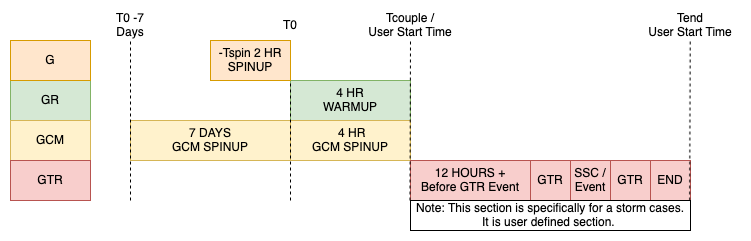
The run is divided into segments:
geospace-SPINUP.*This segment runs the GAMERA model to create the initial conditions for the simulation. It is run first, and its output is used by the next segment.
geospace-WARMUP-**.*These segments runs the GAMERA RAIJU model to “warm up” for for the coupled model execution. The
-01,-02, etc. suffixes indicate the segment number, and the segments are run in order.
tiegcm_standalone-**.*This segment runs the TIEGCM model to create the initial conditions for the coupled model. The
-01to-08. suffixes indicate the segment number, and the segments are run in order.
geospace-**.*These segments runs the GTR coupled modele. The
-01,-02, etc. suffixes indicate the segment number, and the segments are run in order.
This image shows how the segments are run in order:
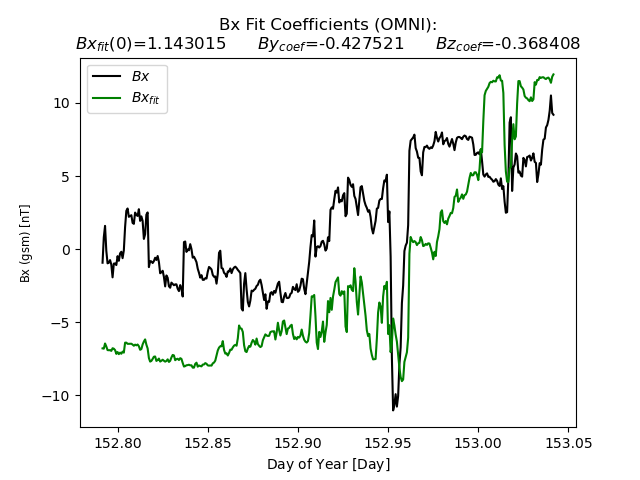
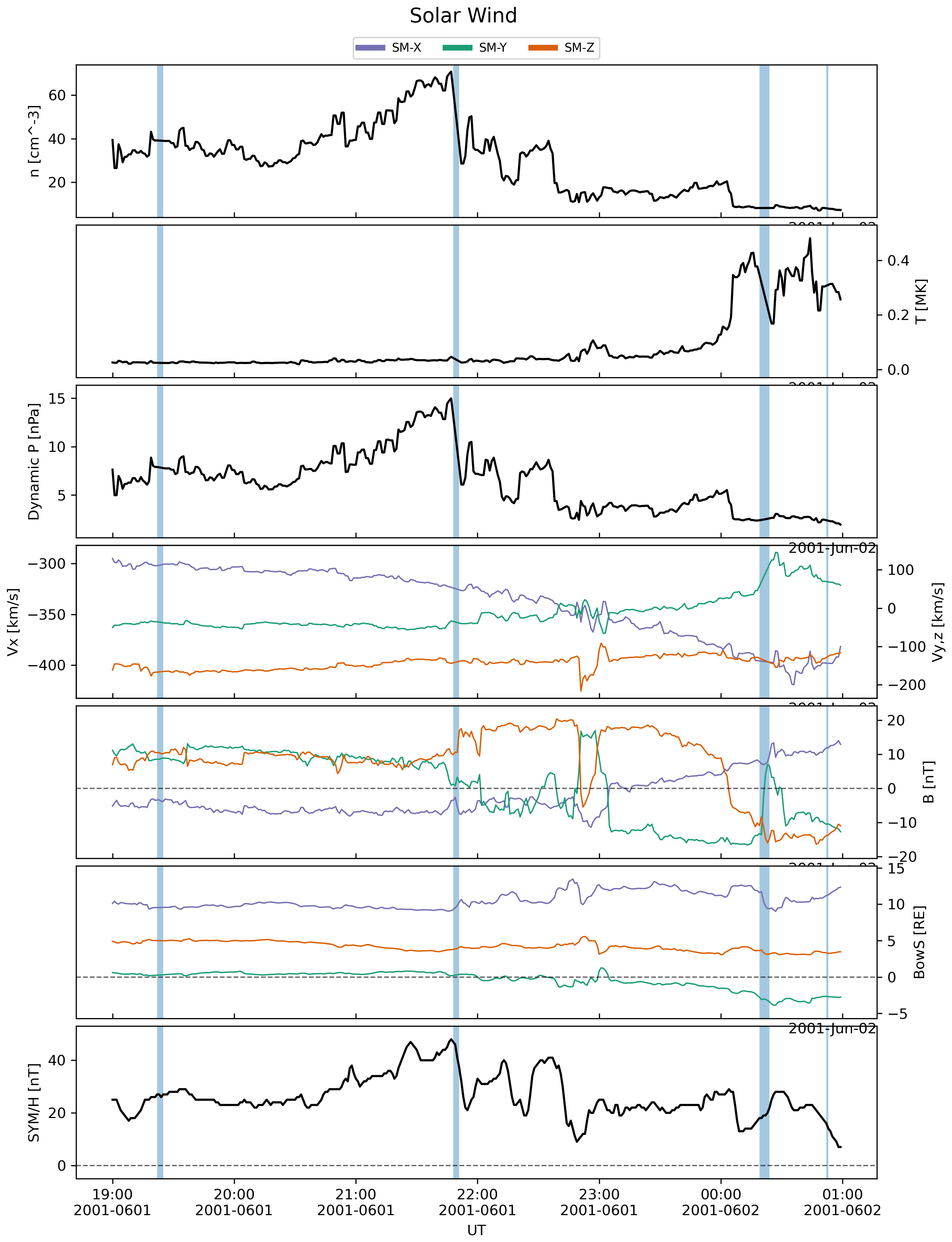
The image files are summaries of the CDAWeb data used in the initial condition
file (bcwind.h5). Those plots should look similar to this:
Submitting the GTR model run
Finally, submit the model run using the script generated by engage.py.
You will see the resulting PBS job ID (your job ID will differ from what is
shown below).
bash geospace_pbs.sh
9770226.desched1
9770227.desched1
9770228.desched1
9770229.desched1
9770230.desched1
9770231.desched1
9770232.desched1
9770233.desched1
9770234.desched1
9770235.desched1
9770236.desched1
9770237.desched1
9770238.desched1
9770239.desched1
9770240.desched1
Understanding the output files of the GTR model run
Once the job is started in the queue, it should take about 80 minutes to run
(on derecho). When complete, you will see many new HDF5 files in your
run directory, along with PBS housekeeping files and logs. The most important
files are (repeated upper-case letters in the names represent integer
strings):
geospace_LLLLL_MMMMM_NNNNN_IIIII_JJJJJ_KKKKK.gam.h5These files contain the core MHD variables from the simulation, computed by the GAMERA portion of the MAGE model. The strings
LLLLL,MMMMM, andNNNNNcontain the number of subsections of theX,Y, andZdimensions used to divide the domain among MPI ranks. The stringsIIIII,JJJJJ, andKKKKKrepresent the MPI rank index along each dimension.geospace.mix.h5geospace.raiju.h5This file contains the results from the RAIJU portion of the MAGE model.
geospace_sech_*.ncgeospace_*.gam.Res.RRRRR.h5These are checkpoint files generated during the simulation which can be used as restart points for future simulations.
geospace_prim_*.ncThese are the primary output files from the TIEGCM portion of the model that are designed as checkpoint files.
geospace_temp_*.ncThese are temporary output files from the TIEGCM portion of the model
Visualizing the results
Now perform a quick visualization of the results from your model using the
msphpic.py script, provided in the kaipy package.
msphpic.py -id geospace
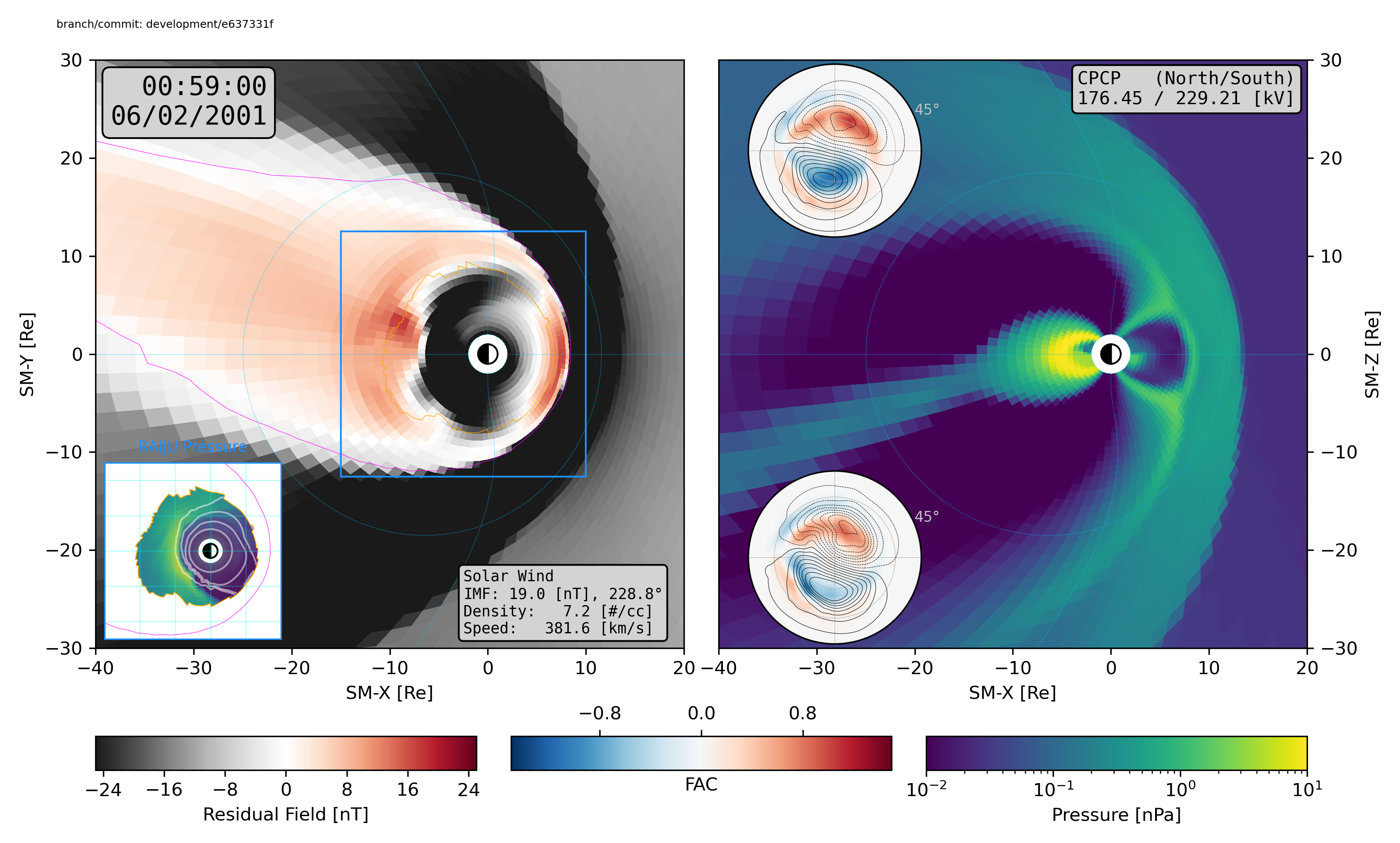
This script will create a file called qkmsphpic.png, which should look
similar to this: